Waiting Field is an exhibition of immersive video installations by four emerging artists exploring the intersection of cinema and visual art. Like a field shaped by time and subtle shifts, the exhibition reflects on waiting – as a condition, a space, and a method –where images and meanings slowly take form.
Featuring works by Alexandra Pavlovskaya-Lokchine, Kimia Khedri, Michał Kucharski, and Lyy Raitala.
Opening: Friday, 6 June from 19:00 to 23:00 Exhibition hours: from Saturday 7 June to Tuesday 10 June, 13:00-19:00 and Wednesday, 11 June, 13:00-16:00
The title Waiting Field refers to a space that is both literal and metaphorical – a place shaped by time, transformation, and anticipation. The exhibition reflects the temporal nature of video and the quiet tension of waiting: for meaning, for resolution, for something to emerge.Working in the undefined space between film and visual art, each artist approaches video not just as a storytelling device but as a sculptural, spatial, and conceptual medium. Their works explore the thresholds between reality and fiction, absence and presence, stillness and movement.
Kimia Khedri (b. 2003, Tehran, Iran) is a visual artist based in The Hague. She investigates disorientation, memory, and the invisible connections between identity and place.
Alexandra Pavlovskaya-Lokchine (born 2002 in Moscow, Russia) is a visual artist and cinematographer based in the Hague and in Paris. She captures suspended moments — foggy landscapes, deserted alleys — where time feels paused and memory lingers.
Michał Kucharski (born in 1997 in Krakow, Poland) is a visual artist based in The Hague, working primarily with videography and photography. With his work, he approaches the medium as a sculptural object, examining how narratives unfold through space and tension.
Lyy Raitala (1999) is a Finnish lens-based artist living in the Netherlands. She constructs surreal, fragmented scenes drawn from everyday life, using humor and subtle interventions to destabilize the familiar.
Together, these works form a shared terrain – a waiting field – where the moving image becomes a site of reflection, transformation, and encounter.
On Sunday, June 1st, Quartair receives Pi Quartet for their debut concert.
Based in The Hague,Pi Quartet is a half-American, half-Dutch string quartet dedicated to neo-classical, contemporary, and experimental music. Composed of Leah Plave (cello), Lidwine Dam (viola), Leslee Smucker (violin), and Hoei Lien The (violin), the ensemble formed out of a shared passion for multidisciplinary performance and curiosity for music beyond the traditional canon. The name Pi, referencing the mathematical symbol π, symbolizes unity, harmony, and infinite potential as well as the quartet’s sensitivity to space and context in performance.
Program: Caroline Shaw – Entr’acte Arvo Pärt – Summa Philip Glass – Strijkkwartet nr. 5 Osvaldo Golijov – Tenebrae
An exhibition displaying a rich collection of Mayan textiles in dialogue with installation works by Miriam L’Herminez. Curated by Marina Manger Cats
From 17 to 25 May 2025 Opening times: from Wednesday to Sunday, from 13:00-17:00 Lecture: A Tapestry of Diversity, Saturday 17th May, from 15:00 to 16:30 Poetry reading: Sunday 18th May, from 15:00 to 16:30 Hoogtij Den Haag: Friday 23 May, open until 23:00 Finissage: Sunday, 25th May at 16:00, screening documentary “Tapestries of Light, Life and Community” & discussion
Coloured Connection juxtaposes highly colourful textiles, traditionally woven and embroidered by indigenous Guatemalan women with the contemporary approach of artist Miriam L’Herminez. The large collection on show displays the traditional blouses known as ‘Huipiles’ and other garments that were made mainly in the 1970s, 1980s and 1990s by indigenous Maya women, coming from different villages of Guatemala. The textiles, true pieces of art, bear specific colours, patterns and characters and come from private collections.
The weaving culture is passed down from mother to daughter for centuries, and forms an important part of the Maya identity, with the technique itself, as well as the patterns and symbols, that stem from pre-Columbian times and Mayan mythology. Here, the Maya’s cosmovision plays an important role, whereby humans are not central to the world, but are part of the nature around them. Maya weaving was also a kind of hidden language and cultural expression, where values and identity could be preserved despite oppression by the Spanish conquistadores and destruction of ancient Maya books and other cultural expressions. Maya weaving is now suffering under the influence of globalisation, commerce and machine reproduction, with special weaving knowledge and its own culture and values being lost.
The extraordinary Guatemalan Maya weaving inspired Dutch multimedia artist Miriam L’Herminez to create works using textiles and other materials, with an eye for the special, Guatemalan indigenous culture and identity. In doing so, she seeks a connection between our culture and that of the Maya, exploring the fragility of people, culture and materials in a special way. She embraces the universal, the human, without giving it a precise face.
About the artist Miriam L’Herminez is a visual artist, trained as a doctor. She draws inspiration from themes such as diversity, connection and people-to-people conversation. An important source for her work is a 15-year stay as a doctor in Malawi, Zimbabwe and Tanzania. During her work, she was touched by barriers that can emerge unintentionally within human interactions. Cultural differences, language and emotional codes sometimes prove unbridgeable. Where do we find each other through the differences? L’Herminez takes the colourful Mayan textiles to explore forms of connection across cultures and celebrate diversity. Visit: www.lherminez.com
Lecture: Guatemala, A Tapestry of Diversity
On Saturday, 17 May, Maria Veronica Sajbin, advisor to INGUAT on Indigenous Populations, spoke about the richness of Guatemala’s weaving cultures. This lecture was made possible through the collaboration with INGUAT, the Guatemalan Institute of Tourism and with simultaneous translation by Valeria Guzman.
Poetry reading
On Sunday, 18 May, we received Mirjam Musch reciting poems from her own work and from Guatemalan poets (in Spanish and Dutch). Guatemalan guest speakers recited poems by Guatemalan Maya women (in Spanish, Kaqchikel and English) including poems by Rosa Chavez, Negma Coy, Irma Nimatuj, and Javier Payeras.
Mirjam Musch is a Dutch writer and poet who worked in Guatemala. Migration, resilience, and the possibility of finding beauty and connection in the midst of disruption are central themes of her work. Her Poetry collections are Bloedlijn ; Voces entre dos orillas-Stemmen tussen twee oevers ; Encuentros – Gedichten op reis; Steggy y el Meteorito.. Visit also: www.mirjammusch.com
Negma Coy is a Kaqchikel Mayan artist. She works in the community to ensure the art and knowledge of the Maya communities continue to flourish. She is a writer and poet, painter, backstrap-loom weaving instructor, and cultural promoter. Books she has published include: XXXK’, I Am an Owl, Canvases of Inheritance, On the Shores of Fire, Tz’ula’ – Guardians of the Roads, and the Kikotem Collection – Kaqchikel Stories, Tales, and Poetry.
Finissage 25 May: film screening at 16:00 Tapestries of Light, Life, and Community in Guatemala
The film weaves together the stories of women who have led legislative initiatives, shaped national policies, fought for human rights, built collective movements, and created spaces for art and activism—all in the pursuit of peace, justice, freedom, and a life without fear. Their journeys reveal that the strength of their communities has been the key to their transformation. The screening was followed by a short discussion.
About the curator Marina Manger Cats grew up in Guatemala and worked there later as a doctor at community level. She and her mother collected ‘huipiles’ and other textiles over the years. Marina brought together artworks from other private collections to give a broad picture of Guatemalan weaving art in this exhibition. She comments that often people visiting Guatemala, whilst touring the ‘hotspots for tourists’, hardly have time for, nor are introduced to the many aspects of Mayan culture. They may see women in Mayan clothing on the streets, but they miss the crucial role of women in weaving, with their incredible creativity and mathematical skills, learned at an early age, with a lot of counting and puzzling involved. The tourists are often not aware of the deep meaning, cultural identity and heritage that lies behind the weaving designs, nor the social functions of the weaving itself.
Although the huipiles are sold at affordable prices to tourists, it may take months of work to make just one. Weaving not only contributes to the family income but also contributes to mental health, due to the meditative focus required in the process, weavers tell us. Therefore, Manger Cats hopes to strike the public’s curiosity and enthusiasm about the beauty, complexity, and background of textile work and its meanings: the heritage of Mayan culture, the link to Mayan mythology of the designs, and the role of this textile production in guarding Mayan identity and cosmovision in today’s globalized world.
Donations and income from the sale of L’Herminez’ artworks and postcards benefit weaving schools for girls and young women (through the Guatemalan organisation AFEDES/MNT) to preserve Maya weaving as cultural heritage.
Supported by the Embassy of Guatemala and Instituto Guatemalteco de Turismo (INGUAT).
From April 11th to 13th, 2025, the graduating class of the ArtScience Interfaculty will present [seventeen frequencies], a three day exhibition taking place at two locations, Quartair and Paradise (Groenewegje 136).
Opening hours: Friday, April 11 from 7PM to 11PM Saturday, April 12 from 12 to 10PM Sunday, April 13 from 10AM to 6PM
The ArtScience Interfaculty offers an interdisciplinary bachelor’s and master’s programme that fosters curiosity driven research as an approach for the making of art. The programme considers art and science as a continuum and promotes the development of new art forms and artistic languages. The ArtScience Interfaculty is embedded in both the Royal Conservatoire and The Royal Academy for Fine Arts in The Hague, The Netherlands. Read more on: interfaculty.nl
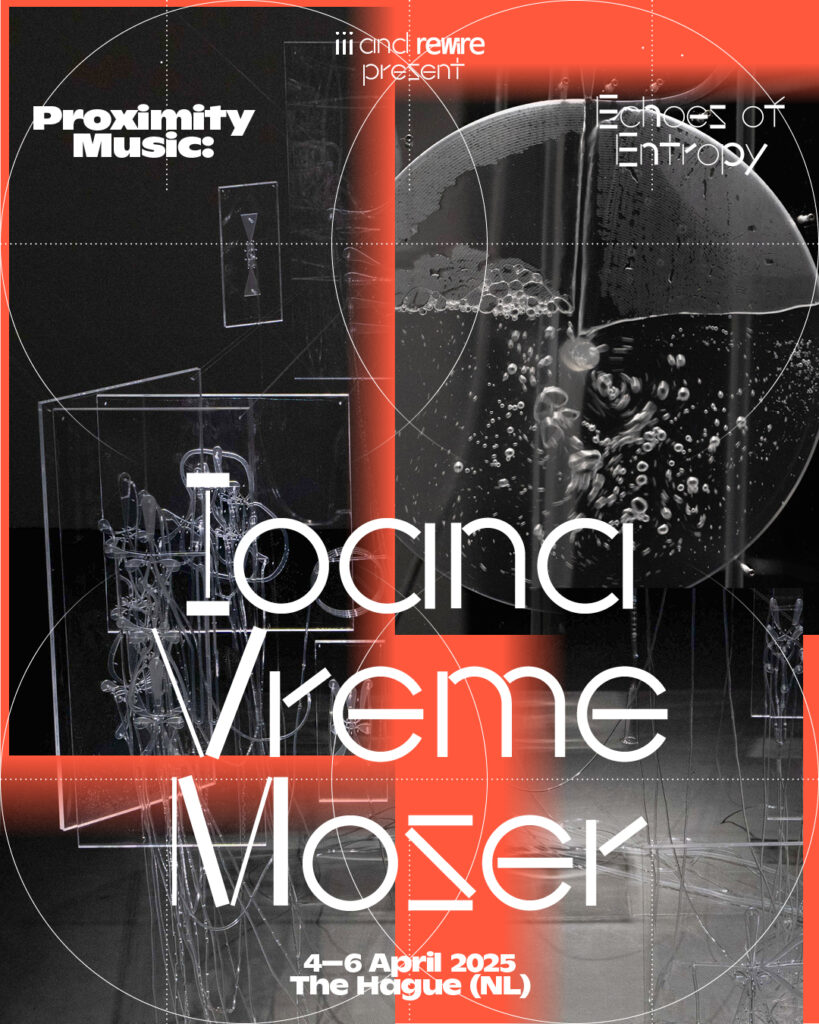
During Rewire Festival (April 4-6), once again Quartair will host the joint exhibition program by iii, Proximity Music: Echoes of Entropy. For this year, iii has selected artist Ioana Vreme Moser to present Fluid Anatomy at our project space.
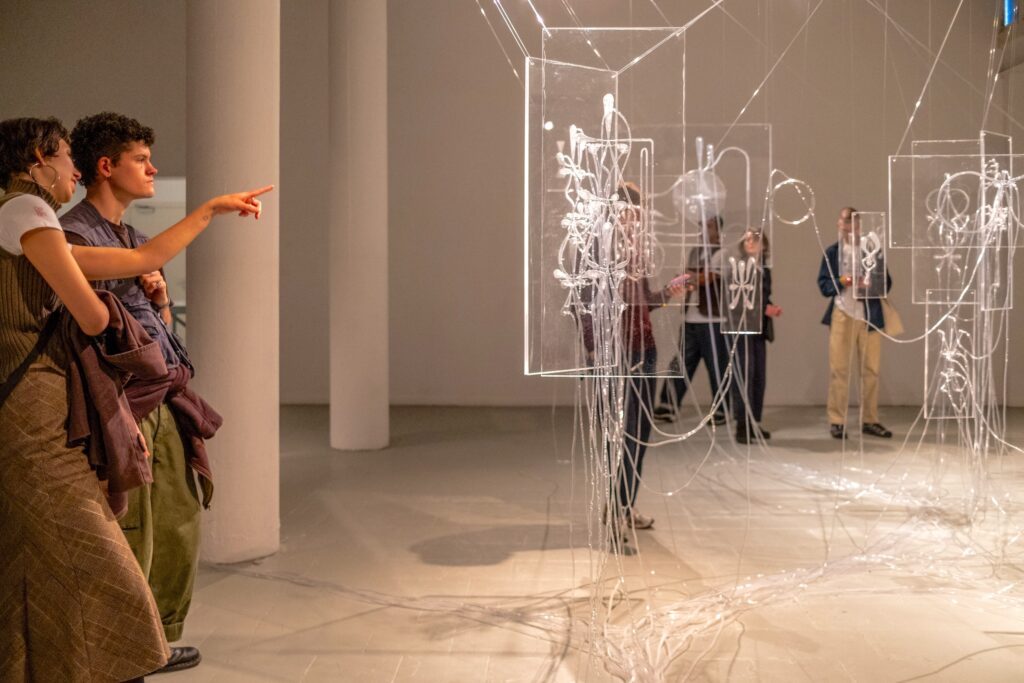
installation ‘Fluid Anatomy’ by Ioana Vreme Moser. Photo by Dana LaMonda
Powered entirely by water and air, Ioana Vreme Moser’s Fluid Anatomy uses oscillators, valves, pumps, and connecting hoses to create a dynamic analogue installation responding to the environment of Quartair. Taking inspiration from mid-twentieth century “liquid computers” (powered by the flow of liquids), Vreme Moser highlights the beauty and resilience of this alternative computational model to question present-day technological narratives. As the installation passes from one rhythmic pattern to another, the public is invited to walk amongst fragile fluidic bodies and experience the intriguing play of forms and sounds that water and air produce.
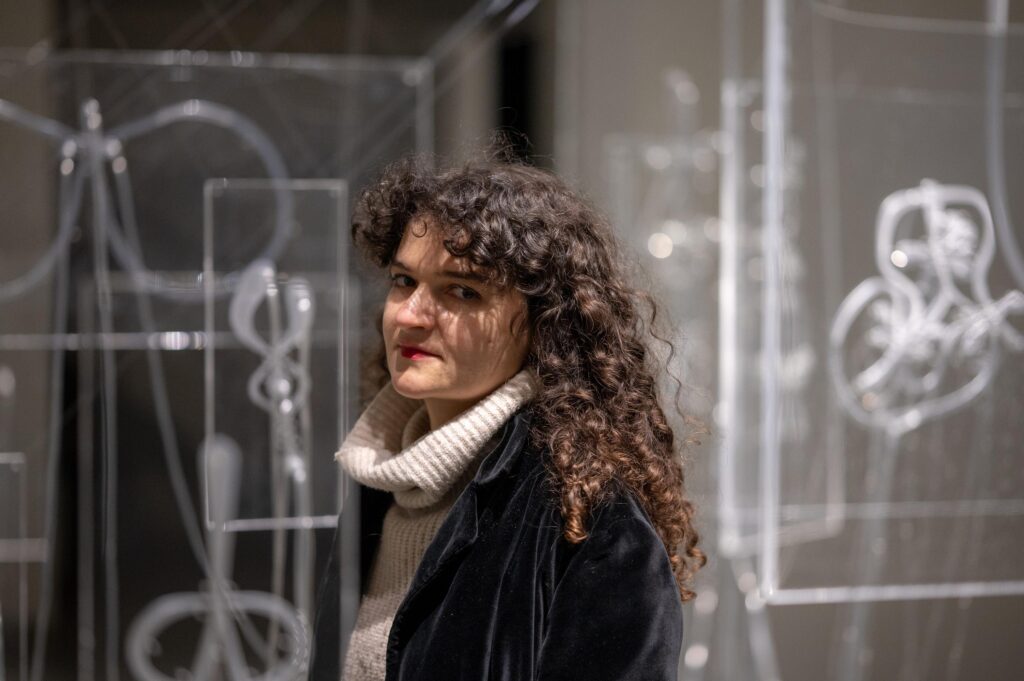
Ioana Vreme Moser is a Romanian sound artist interested in hardware electronics, speculative research, and tactile experimentation. In her practice, she uses rough electronic processes to obtain different materialities of sound. She places electronic components and control voltages in different situations of interaction with her body, organic materials, and environmental stimuli. Vreme Moser’s works feature personal narrations and observations on the history of electronics, and their production chains, wastelands, and entanglements in the natural world.
The installation is produced and curated by singuhr projekte, with support of Musikfonds, Bezirksamt Pankow, Berlin. Technical support: Dorian Largen, Jan Rohmer, FabLab.ro. And special thanks for research support: Benjamin Bühling
Proximity Music: Echoes of Entropy presents a series of works that help us understand how chaos and entropy act as forces of creation and catalysts for change while critically examining their impact on our present-day world. Drawing inspiration from the second law of thermodynamics, where entropy signifies the inevitable drift towards disorder, the artists delve into the consequences of these forces on our environment, socio-political systems, and human interactions. Taking these complex and ephemeral relationships as their starting point, the participating artists make chaos tangible by navigating the complex interplay between disorder, chance, and creation. Rather than evoking fear, the works embrace unpredictability and the beauty of uncontrollability. Curated by Yannik Güldner, featuring works by Zimoun, Navid Navab, Natalia (Nika) Sorzano, Ioana Vreme Moser, Coralie Vogelaar, Chris Salter & Marije Baalman, Aura Satz.
Entrance to the Proximity Music exhibition is free. Opening hours: from 12:00 to 20:00.
Proximity Music is the joint exhibition program initiated by iii and Rewire. It seeks to connect music, architecture, technology, ritual, and play through physical experiences engaging with all the senses.
From February 27 to March 16, Quartair will present Drawing Inventions 2025. The forty-seven participating artists have followed the Drawing Inventions Academy, a master program guided by Arno Kramer, Caren van Herwaarden and Marisa Rappard. In this masters, artists are encouraged to reflect on their owns and each other’s works and make new steps in their development. The works of this exhibition have been selected under the supervision of Arno Kramer, visual artist and advocate of drawing art as an autonomous discipline in the Netherlands.
artist Tienke Zijlstra at her studio
Opening on March 1st, 16.00 –18.00 Hoogtij on March 7th, 19.00–23.00 Finisage on March 16, 16.00 – 18.00
Opening hours: Thursday to Sunday, between 12.00 and 18.00
Participating artists: Ana Rocha, Anja Sijben, Anna J van Stuijvenberg, Anne-Marie Joosten, Carien Vugts, Cindy van Woudenberg, Dick van Dijk, Egbert Jan Brink, Esther Eggink, Gerard Pouw, Godelieve Smulders, Hellen Abma, Helma Mostart, Hils Robbé, Ike Smitskamp, Inge van der Storm, Ingrid Pasmans, Iris Frerichs, Jeroen Paalvast, Josė Krijnen, Kai Kuper, Lea Adriaans ✝, Maja Badnjević, Mara Liem, Marie-Josée Comello, Marieke Smink, Marielle van den Bergh, Marijke Breuers, Marijke de Pous, Marike Hoekstra, Marjolein Spitteler, Mark Schalken, Marly Hendricks, Michiel Knaven, Monique van Stokkum, Nelleke Bosland, Rita Rutten, Sander Wiersma, Sarah Linde, Sonja Hillen, Sophie Mastenbroek, Susana Mulas Lastra, Teodora Ionescu, Thea Zweerink, Tienke Zijlstra, Ursula Metzler, and Wilma Stegeman.
Drawing Inventions 2025 (detail) at Quartair, The Hague from Feb 27 to March 16, 2025
Tabaria Café is a pop-up café bridging past and present, aiming to honour and preserve Palestinian culture. Tabaria Café began as a dream of resistance, rooted in the history of exile and the fight for liberation. One year later, it has become a space of solidarity, community, and hope for Palestinians and the SWANA diaspora in the Netherlands.
From Friday, February 7th through Sunday 9th, each day from 1 PM – 6 PM, Quartair created a space for gathering and reflecting on what Tabaria Café has been built together, sharing its journey, and the ongoing struggle for justice and liberation.
We were honored to feature Maisara Baroud, a talented Gazan artist, whose mural from his collection ‘I’m Still Alive’ will be part of the exhibition. Through timelines, stories, and art, we honor the resilience of the past and the hope of the future.
I’m still alive, reproduction of mural series by Gazan artist Maisara Baroud
The centre piece of the exhibition was a mural reproduction of Gazan artist Maisara Baroud from the collection I’m Still Alive. Contorted bodies are illustrated in various states of being, from a calm figure whose stillness is about to be disrupted by missiles in the background, to figures whose pain of loss is expressed in dispositions of death and grief. Despite being forced to move his family ten times, Baroud continues documenting the destruction happening around him. The title I’m Still Alive is a testament to his resilience and resistance against a genocidal occupation.
Our deep thanks to the volunteers who painted it Quartair.
Program:
Feb 7 Broadcast on how to preserve Palestinian heritage Radio Intuitive Embroidery / Tatreez workshop (14.00-17.00) Evening: The Bonfire Diwan: Storytelling inside/outside, recorded by radio (18.00-20.00)
Feb 8 Crochet workshop (all day) Evening: Film screening: Bye bye Tiberia/Jenin Jenin/Arna’s Children (17.00-18.30)
Feb 9 Collective Brunch (13.00-15.00) Music evening (17.30-18.30)
A Year in Exile: Intuitive Embroidery / Tatreez workshop at Quartair
The program also included on-going Learning Palestine: 12-hour radio programme; a reading corner, a craft corner, and letter writing: dedicated to palestinian political prisoners.
Once again, in collaboration with Nine Dragon Heads, Quartair participates in the Sarajevo Winter Festival / Sarajevska zima, from Feb 5th to 12th, 2025. Quartair will present works and performances by Jessy Rahman, Ilona Senghore, Ira van der Valk, Dana LaMonda, Paul Bruijninckx, Anja Zwanenburg and Paul Donker Duyvis. With thanks to Stroom Den Haag.
tentoonstelling van 23 november t/m 15 december opening 23 november van 19 tot 23 uur – met optreden van danser charlie skuy openingstijden vrijdag t/m zondag van 13 – 17.30 uur HOOGTIJ #79 vrijdag 29 november van 19 – 23 uur – ève-marie dalcourt danst een special voor haar gemaakte choreografie van dimo milev
met:
lieske van de seijp john mckellar nies vooijs luka smišek annemieke louwerens merel van erpers roijaards willem marijs siem salaboem guus rijven scott van kampen wieling hélène penninga ellen yiu
met dank aan vino vero ecologische wijnen
EN
Quartair’s closing exhibition of 2024 is an ode to The Hague’s art scene. The title refers not only to local talents, but also to the different hues, or the subjectivity of each participating artist. The exhibition, curated by Annemieke Louwerens, presents works from different disciplines by artists either born or currently based in the city. From recently graduated KABK alumni to some of the longest established artists, what connects them is their playful creative processes.
Photography, paintings, sculptures, installations and video works come together in a dynamic symbiosis, where each work bears its own story while engaging in a dialogue with the other works in the space. By presenting these pieces side by side, a cross-pollination will occur, where new meanings and interpretations may be born. The public is invited to explore the interrelations that will emerge from this context.
During the opening, on November 23, dancer Charlie Skuy (NDT) performed among the artworks. During Hoogtij, on November 29, dancer Ève-Marie Dalcourt performed a choreography by Dimo Milev.
To Bloom () Florecimiento Saturday, November 16th From 13.00 – 16.00
In collaboration with Stroom Den Haag, we proudly host: To Bloom, an artist talk, film screening, and experiential performance ‘Ancestral Bodies’ with Amanda Piña.
To Bloom is the first iteration of a year-long collaboration between Stroom Den Haag and Amanda Piña and the School of Water and Mountains as part of the program Borrowed Time.
November 16th at Quartair for To Bloom Entrance and includes free drinks and lunch
To Bloom () Florecimiento with Amanda Piña. Together with participants, we want to explore how our sense of time, shaped by local histories, environmental concerns, and current challenges, affects how we imagine our collective past and future. By bringing together ecology, ancestry, and alternative knowledge systems, we aim to move away from individualistic and exploitative thinking, to instead think through interconnected approaches that focus on responsibility, healing, and envisioning new possibilities for the future.
As we seek to adapt to a burning planet, we must rethink how we live, perceive, and experience the world. What role do our collective bodies play in this social, political, and spiritual transformation?
During To Bloom () Florecimiento, Piña shared more about her recent experiences with the Apu Wamani mountain and its extraction by mining companies. From here, she took us along her exploration of other ontologies of water and earth that are at the core of her practice. We discussed her learnings from the School of Mountains and Water and the School of the Jaguar as forms of artistic research centering decolonial praxis. The second part of the program included film screenings of Apu Wamani and Divina Presencia and a guided experience in which we encountered our bodies as ancestral.
Photos by Dana LaMonda, courtesy of Stroom Den Haag
Amanda Piña’s versatile artistic practice reaches from performance, music, and video to textile works and is to be found in the context of the theater, the museum, and beyond.In her most recent work, Amanda Piña addresses the pressing socio-environmental crises by engaging with First Nation educators to explore other forms of relationships with mountains, glaciers, rivers, and the ocean. Through these collaborations Piña is able to compile non-western ontologies of water and earth that emphasize the body.
As a multidisciplinary artist, Piña works through choreographic and dance research, creating, curating and working within art institutions, university and artistic educational frameworks. Her practice also involves writing and editing publications around what she refers to as ‘endangered human movement practices.’ To Bloom () Florecimiento is an ongoing research project investigating the power of embodied practices to foster societal transformation and contribute to the decolonization of the senses. It also serves as the title for various artistic works across different media that are part of this initiative. The term blooming refers to ancestral Mesoamerican ritual practices that aim at achieving a fullness of the experience of a relational body. To bloom together, to strengthen ourselves together.
A maximum of 30 people could join the artist talk and interactive performance.